Unlock a world of possibilities! Login now and discover the exclusive benefits awaiting you.

Welcome to
Qlik Community!
Recent Discussions
-
Large Dataset Wide and Long Table Load Times Issue
Hello, I have a data set of 1.3 million rows. For a lot of the visuals I require a long table so when i create a long table it produces 153 million ro... Show MoreHello,
I have a data set of 1.3 million rows. For a lot of the visuals I require a long table so when i create a long table it produces 153 million rows. The widgets have a hard time loading that much data especially when the widget is using the long table. the long table gives me what im looking for in the visuals but the widget loading is really bad, Is there any other options that has the same functionality of the long table?
-
connecting Postgresql db via ssh ?
Hello, does anybody has experience how to get a postgresql dbase connection via ssh? I have tried the 2 possibilities with and without via Direct Acce... Show MoreHello, does anybody has experience how to get a postgresql dbase connection via ssh? I have tried the 2 possibilities with and without
-
Google Drive
Hallo Ich bekomme keine Verbindung mehr zu Google drive. Hier die Fehlermeldung: -
How to list down a record where the data is found in one table but not in anothe...
Dear gurus There are so many similar posts in here but try to understand it may takes some time. Hence i decide to post it here using my table. I hav... Show MoreDear gurus
There are so many similar posts in here but try to understand it may takes some time. Hence i decide to post it here using my table.
I have 2 tables - Staff and Form_Submission. Both table contains column 'Name' and 'UserIds'
In the load editor how am i suppose to write the script so that i want to know which staff in table Staff has never submit a form. I saw lots of example using Not Exist. Just hope that someone can help me by using my scenario here . TQ !
-
Pk handling in Oracle19c
Hi Community, I'm currently working with Oracle 19c as a source, and I've some tables without primary keys. Need to configure a task for a full load w... Show MoreHi Community,
I'm currently working with Oracle 19c as a source, and I've some tables without primary keys. Need to configure a task for a full load with Change Data Capture (CDC). How should I proceed in managing the absence of primary keys in this scenario? Your guidance on handling this situation would be greatly appreciated.
Regards,
Pranita
-
Connexion à une base de données HFSQL
Bonjour, Je rencontre actuellement un problème de connexion à une base de données hfsql Type de base de données : JDBC généralURL : jd... Show More -
Auto ML experiment field missing ?
Hello Everyone, I am new to Qlick and use trial version since yesterday. Following tutorial, it is requested to select "auto ML experiment" from the "... Show MoreHello Everyone, I am new to Qlick and use trial version since yesterday. Following tutorial, it is requested to select "auto ML experiment" from the "Add New" drop down menu. But, This field is missing. I am wondering whether this is because I am using a trial version of Qlick...?
Does someone know about it ?
Thank you for your help
-
Scripting / Transformation Question
Hi all, i have the following two tables:Contracts: ContractID Valid_From Valid_To Risk 123 2003-01-01 2003-12-31 A 123 2003-01-01 2003-12-31 B ... Show MoreHi all,
i have the following two tables:
Contracts:ContractID Valid_From Valid_To Risk 123 2003-01-01 2003-12-31 A 123 2003-01-01 2003-12-31 B 123 2003-01-01 2003-12-31 C 123 2004-01-01 2004-12-31 B 123 2004-01-01 2004-12-31 E Risks:
Risk Risk_Name A Risk_A B Risk_B C Risk_C D Risk_D E Risk_E I am seeking a way to transform the two table into one table with the following structure:
Result:
ContractID Valid_From Valid_To Has_Risk_A Has_Risk_B Has_Risk_C Has_Risk_D Has_Risk_E 123 2003-01-01 2003-12-31 Yes Yes Yes No No 123 2004-01-01 2004-12-31 No No No Yes Yes Of course the Contract table contains multiple ContractIDs with different periods. I am aiming for a result table that contains for every given Valid_From / Valid_To the information whether any of the possible risks is included.
Thanks in advance for some help here!
-
QlikSense Enterprise upgrade from August 2022 to Feb 2024 Failed
Hi All, We were trying to upgrade our QlikSense enterprise version from August 2022 to February 2024. Steps: - All services related to QlikSense wer... Show MoreHi All,
We were trying to upgrade our QlikSense enterprise version from August 2022 to February 2024.
Steps:
- All services related to QlikSense were stopped (PostgreSQL was running).
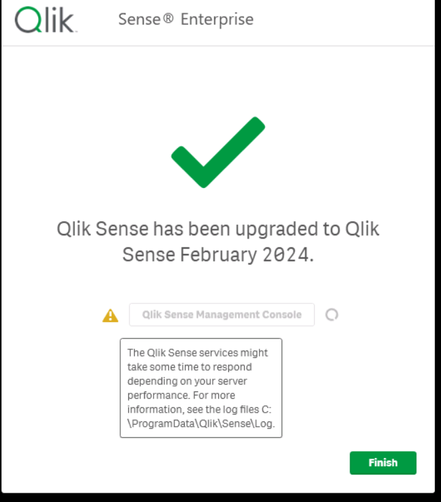
- Installed Feb 2024 version, Installation window was success. Pls see below screen.
- Clicked on Finish.
All the Services which was stopped before the installation was running post this installation. But we were not able to launch/use/ QlikSense.
The Server was not reachable post installation. we captured details from the logs folder and restored the Windows server version with the snapshot.
Please suggest what might be the issues due to which the the server was not reachable post installation.
Thanks in advance.
-
Embedding Charts from Qlik app to a React Website using : Enigma JS & Nebula JS ...
Hey everyone, I figured out how to display charts and insights from a Qlik app on my React website using Enigma JS & Nebula JS. This will come in han... Show MoreHey everyone, I figured out how to display charts and insights from a Qlik app on my React website using Enigma JS & Nebula JS.
This will come in handy, especially if you're working with a client-managed setup, as embedded links and the Capability API support might be a bit lacking.
Now, here's the catch - this method works like a charm for Qlik's stack charts, but if you're jazzing up your charts with extensions like VizLib, you might hit a roadblock. Check out the supported chart types here.
First up, let's connect to your app with Enigma JS
-
Install Enigma JS:
npm install enigma.js -
Bring it into your file:
import enigma from "enigma.js"; import schema from "enigma.js/schemas/12.612.0.json"; -
Time to connect to your Qlik App:
const session = enigma.create({
  schema,
  createSocket: (url) => {
    const socket = new WebSocket(url);
    socket.addEventListener("error", (event) => {
      setError(new Error("WebSocket error"));
      console.error("WebSocket error:", event);
    });
    return socket;
  },
  url: "<ADD THE APP URL HERE>",
});

const global = await session.open();
const app = await global.openDoc("<ADD THE DOC ID HERE>");
Moving on to Nebula JS for chart renderings:
-
Install Nebula JS:
npm install @nebula.js/stardust -
Bring in the "embed" function:
import { embed } from "@nebula.js/stardust"; -
Let's dive into a Pie Chart:
a. Get the sn-pie-chart:
npm i @nebula.js/sn-pie-chartb. Import it:
import snPieChart from "@nebula.js/sn-pie-chart";c. Now, time to put that pie chart on display:
const pieChartNebula = embed(app, {
  types: [
    {
      name: "piechart",
      load: () => Promise.resolve(snPieChart),
    },
  ],
});

pieChartNebula.render({
  element: document.getElementById("pie-chart"),
  id: "<ADD THE PIE CHART'S OBJECT ID>",
});
I wouldn't exactly call this the top-notch method. If you happen to have any other ideas that might work better, I'd be super grateful if you could share them with me!
To know more about Nebula JS APIs - https://qlik.dev/apis/javascript/nebula-js/Connect with Me -











Lots of Qlik Talend Data Integration Sessions!
Wondering about Qlik Talend Data Integration Sessions? There are 11, in addition to all of the Data & Analytics. So meet us in Orlando, June 3 -5.

Qlik Community How To's
Browse our helpful how-to's to learn more about navigating Qlik Community and updating your profile.

Do More with Qlik - Delivering Real-Time, Analytics-Ready Data
Join us on April 24th at 10 AM ET for the next Do More with Qlik webinar focusing on Qlik’s Data Integration & Quality solutions.

Your journey awaits! Join us by Logging in and let the adventure begin.










Customer Story
Qlik Data Integration & Qlik Replicate story
Qlik enables a frictionless migration to AWS cloud by Empresas SB, a group of Chilean health and beauty retail companies employing 10,000 people with 600 points of sale.
Customer Story
Building a Collaborative Analytics Space
Qlik Luminary Stephanie Robinson of JBS USA, the US arm of the global food company employing 70,000 in the US, and over 270,000 people worldwide.
Location and Language Groups
Choose a Group
Join one of our Location and Language groups. Find one that suits you today!
Healthcare User Group
Healthcare User Group
A private group is for healthcare organizations, partners, and Qlik healthcare staff to collaborate and share insights..
Japan Group
Japan
Qlik Communityの日本語のグループです。 Qlik製品に関する日本語資料のダウンロードや質問を日本語で投稿することができます。
Brasil Group
Brazil
Welcome to the group for Brazil users. .All discussions will be in Portuguese.
Blogs
Community News
Hear from your Community team as they tell you about updates to the Qlik Community Platform and more!